

And we’re back, for another year, or more, and it is still raining in Wellington. News today from Auckland is that they are once again having some uncertainty about their building heights and character areas, but Wellington has apparently cleared all that up for our own city. We have sorted out that our city heights need to rise, and no-one seems to be protesting down here – or is it just that I’ve been away for a media-free month? Maybe people are all howling in protest but I just can’t hear them? Or maybe Wellington is all worn out from protesting against the Road and Tunnels plans?
So let’s look in a little more detail. Here’s a pic of the city e-Plan overall, with some features of note turned on.
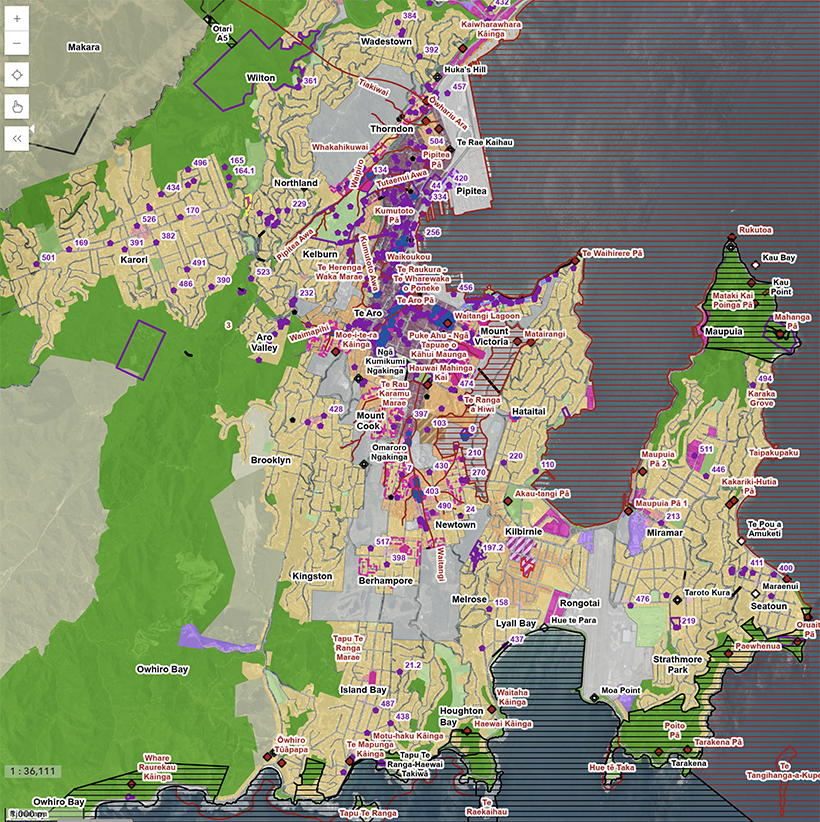
The e-Plan has a load of information locked into it, although it sometimes takes a while to load and to refresh. Best use a powerful computer, not a tiny phone screen. Here, for instance, is a pic with some historic local (underground) streams shown, and the site of the old Te Aro Pā. It also has some pink lines and pink dotted areas shown, but I’ve forgotten what they are about (sorry! must check!!!).
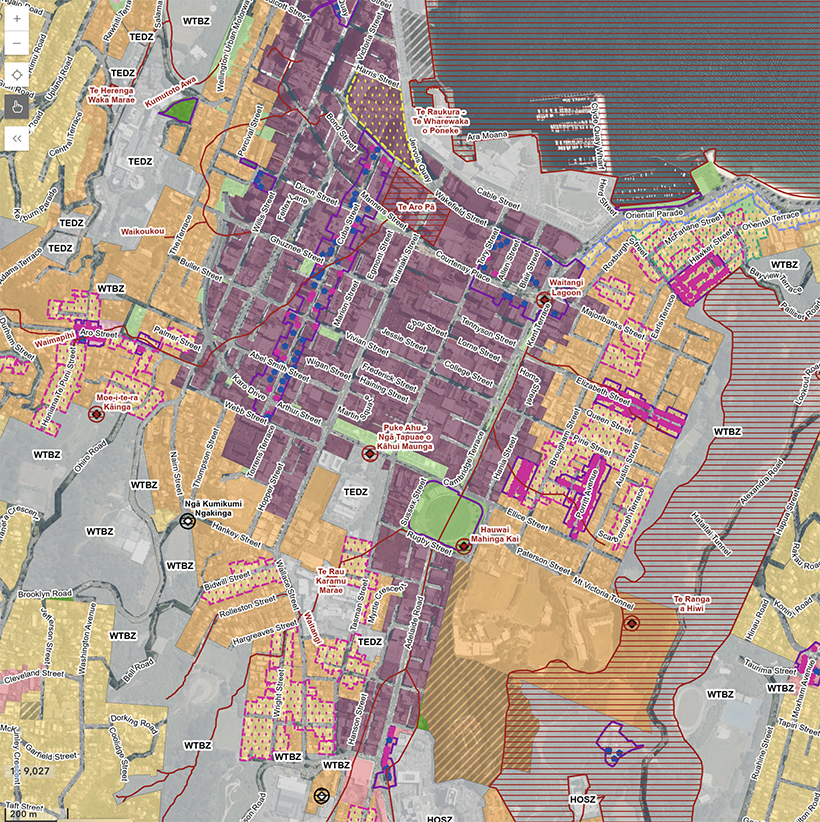
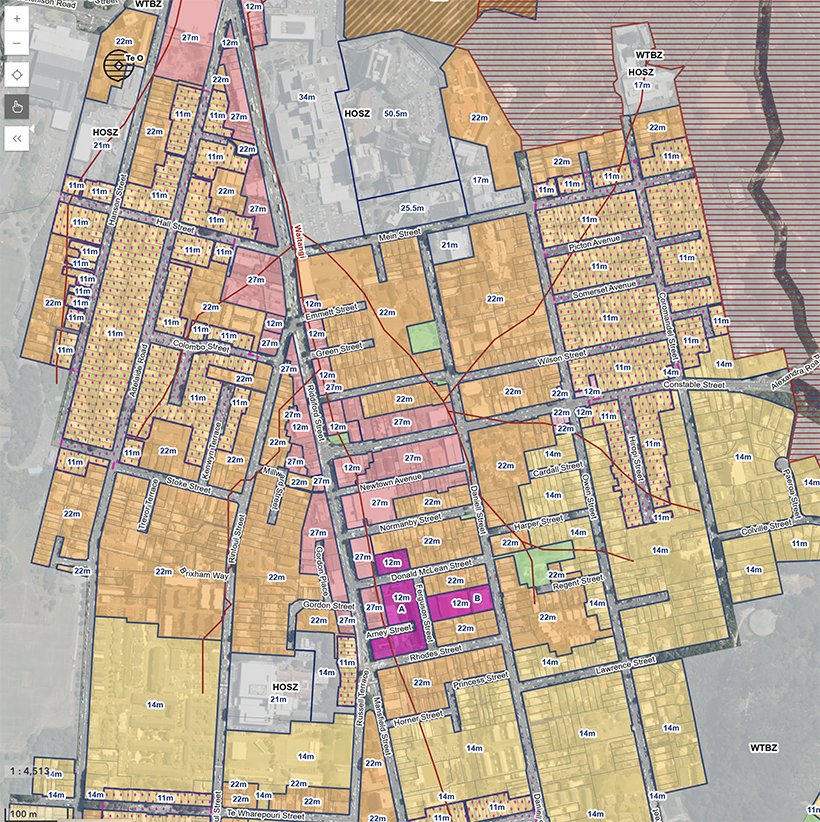
But do you know what your building “height limits” are for the suburb you are in? I suspect that in all the confusion, all the up and down and back and forth, that people may have forgotten what the new heights will ultimately mean. For instance, if you live in Newtown then you may have heights limited to this high (below), which means that a large swathe of Newtown is now scheduled for 22m high (approx 6 storeys), and some for 14m high (4 storeys), but also the main drag down Riddiford Street has a mixture of 27m and 12m – I’m not quite sure why. Please note that from here on, the scale is all the same, but at an awkward 1:4500 (or to be precise, 1:4513), which seemed to be a good size to get whole suburbs shown:
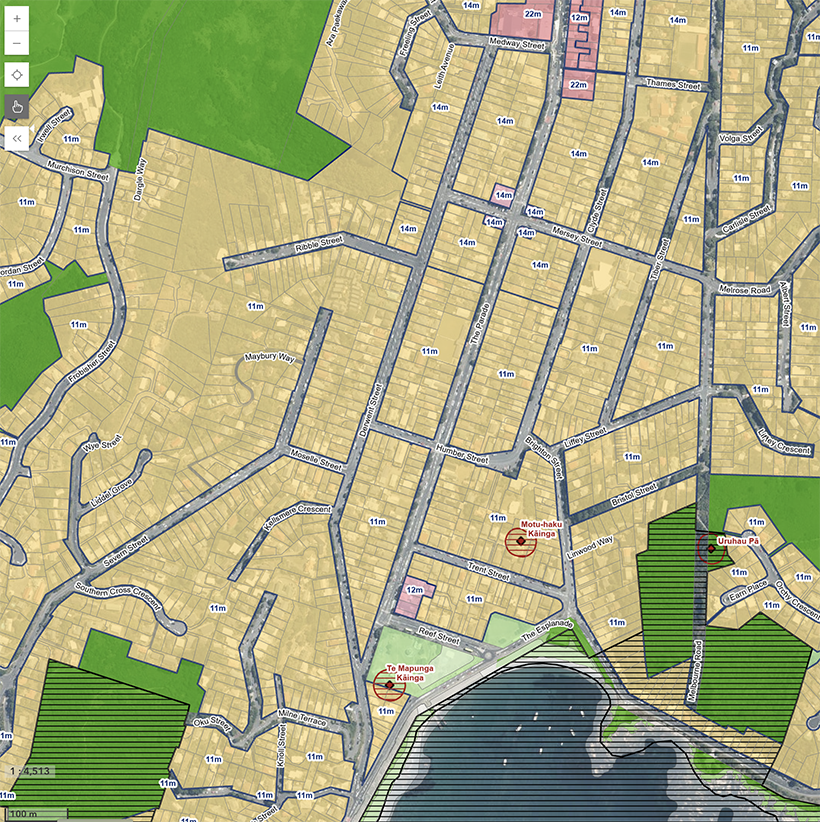
But if you are down in Island Bay (shown below), there are some different changes, especially around the “please intensify me” shopping centre, which now reaches up to 22m, with most of the shops at only 12m, while the surrounding residential suburbs are firmly stuck on 11m (three storeys, the new normal), and some dots of 14m (clearly aiming at four storeys). While some of the local builders have already decided to build new three storey townhouses, I’m not sure that the rest of the residents quite realise yet that three storeys will soon be the norm.
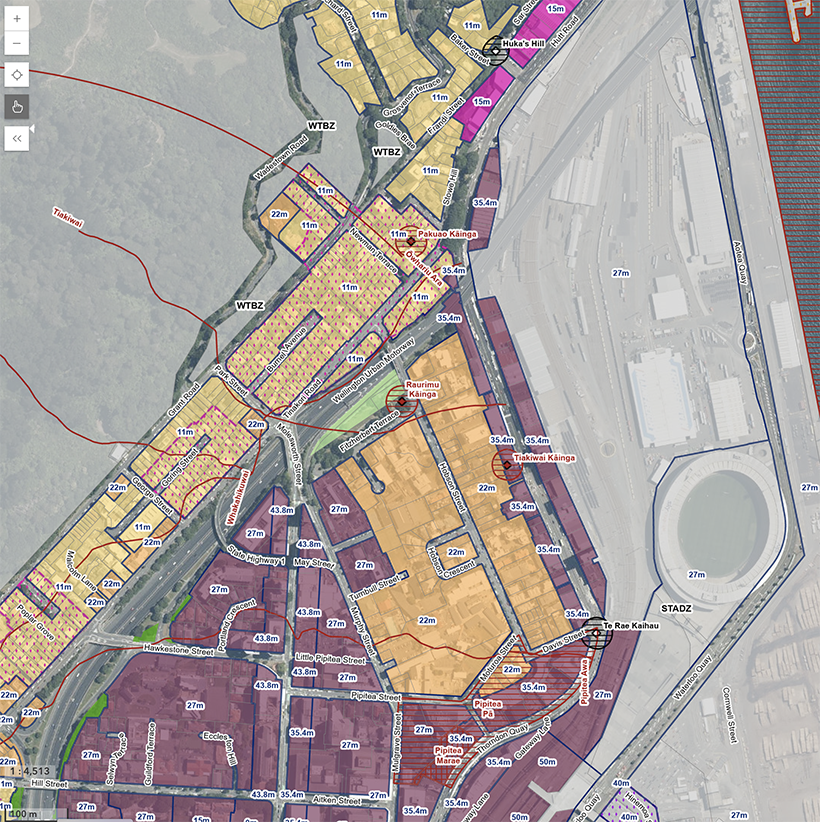
Meanwhile, north of the City, centred around the Beehive and the CakeTin looks like this overall (below), where there is a small amount of Residential land saved at 22m high, while all around has 27m or the oddly specific 43.8m high. I wonder why?
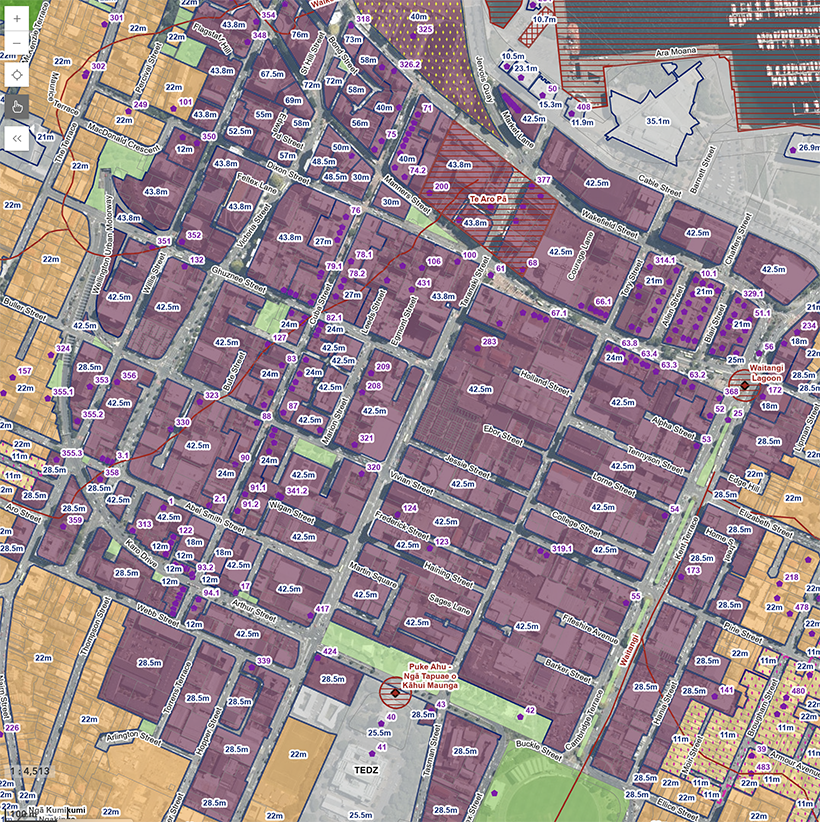
And Te Aro looks more like this close up, with the former twin limits of 27m high (which was meant to be 6 storeys but developers kept pushing it to 9, 10 or 11 storeys), or 42/48m – now it seems that 42.5m is mandated everywhere. Beware Te Aro, you will never see the sun again once this goes ahead:
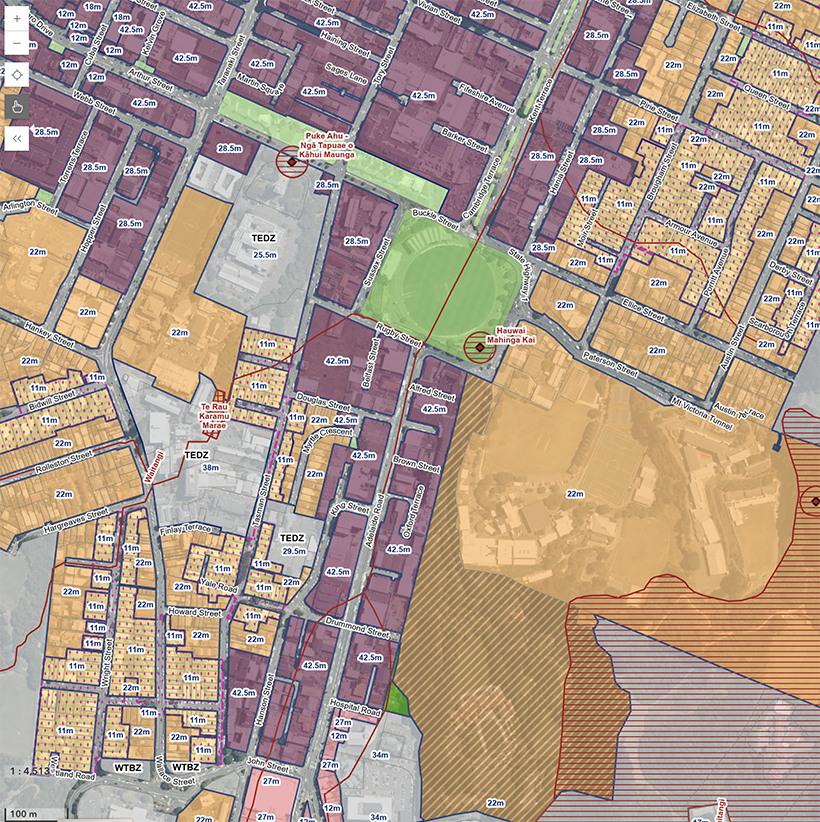
Just to the immediate South of that, around the Basin Reserve, we see a fraction of the side of Mt Victoria and Mt Cook, and the Waitangi Stream meandering down Rolleston Street and passing the site of another old Marae – Te Rau Karamu. At the very bottom of this picture you can make out that on either side of Adelaide Road there are two contributary streams, showing just what a poor location Adelaide Road really is for tall buildings, as the ground is all mud, not rock.
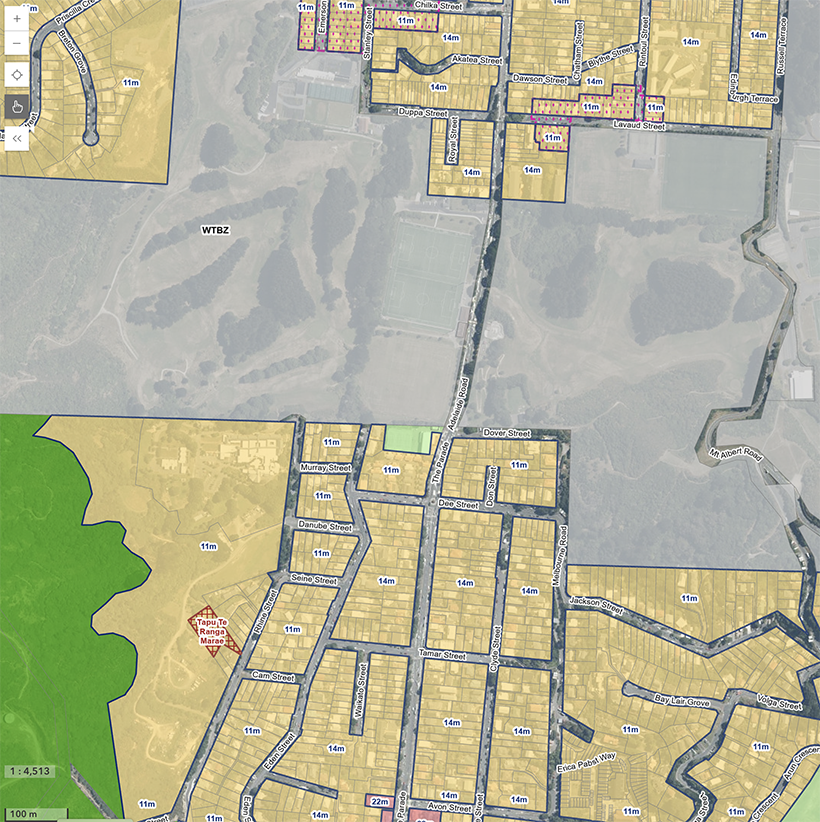
Further South we hit the Green Belt where the terrible Berhampore Golf Course crosses the Adelaide Road, although honestly it is rubbish for playing golf on. But I suspect that the owners of all the exceptionally tiny houses in B Pore will be astonished to find three storeys going up next door:
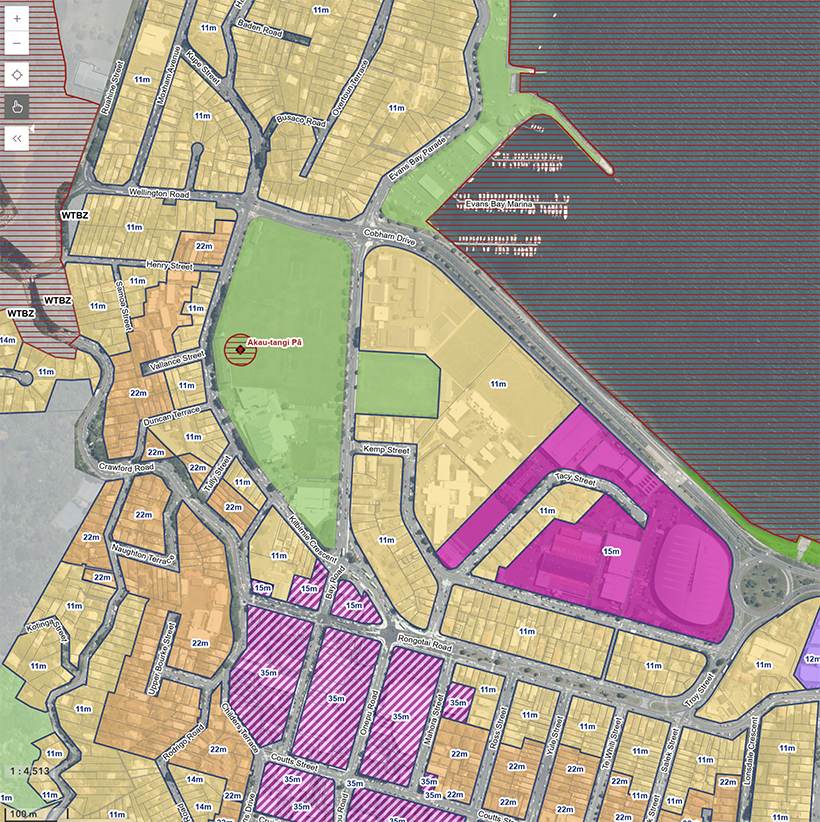
Meanwhile in Evans Bay and Kilbirnie, the 11m / 22m split continues onward, with the exciting promotion of Kilbirnie as a venue for an extensive array of 35m high buildings to replace that awful rundown shopping centre there at the present:
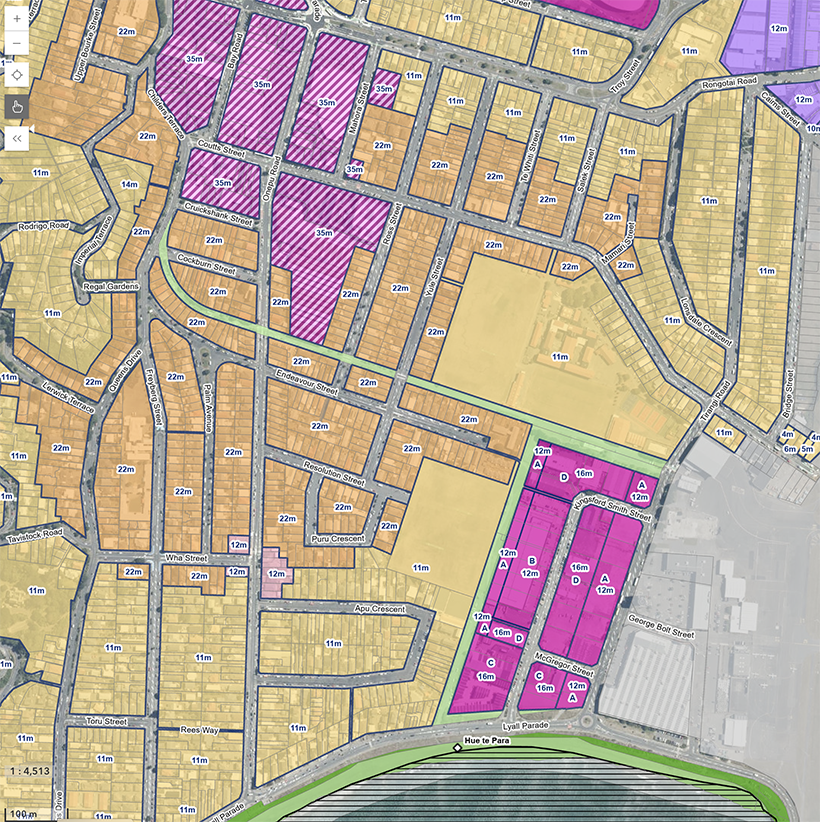
Just below that, we can see that Lyall Bay has got similar height treatment, although lower over by George Bolt Drive in case planes get in the way:
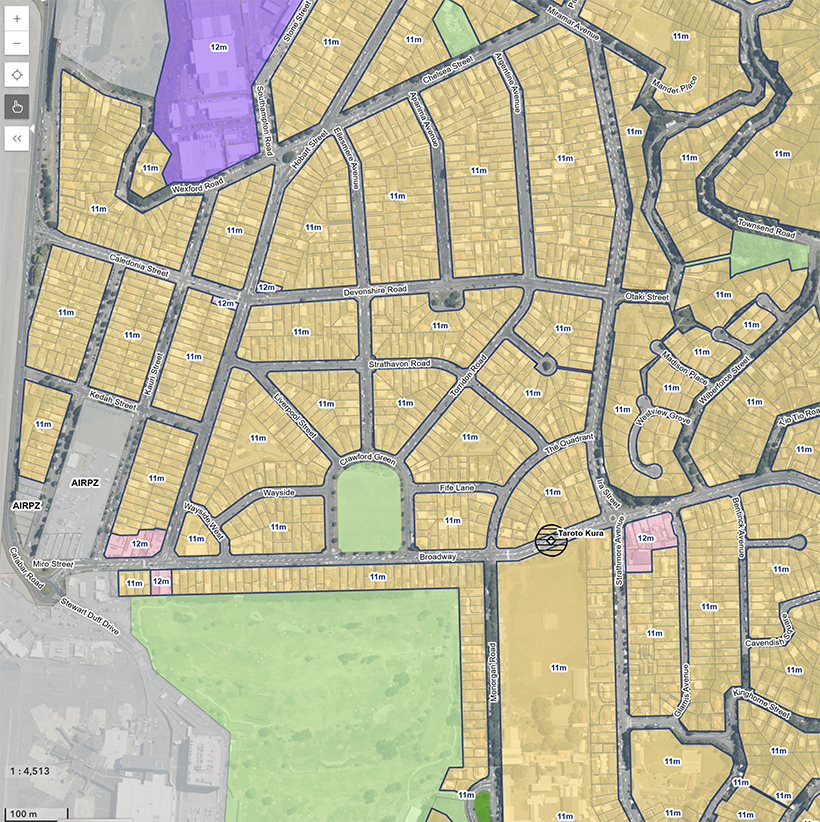
Over in Miramar, the Belle by the Sea, it is all fairly straightforward: its 11m all round:
We might continue this on another day, but perhaps first I should try and make a small table that has some correlation between heights in metres and heights in storeys:
1 storey = 3m tall (approx) – 2.7m stud height plus 300mm flat roof
2 storey = 6m tall (approx) – old (former) height limit for residential was mainly 8m
3 storey = 9m tall (approx) – but some residential areas were 10m
4 storey = 12m tall (approx) – so is 11m meant to encourage 3 storeys with gable roof?
5 storey = 15m tall (approx) – and so is a 14m limit meaning 4 storeys only?
6 storey = 18m tall (approx) – and probably about the limit for timber-framed building
7 storey = 21m tall (approx) – does a 22m limit mean 7 floors and a flat roof?
8 storey = 24m tall (approx) – needs the new materials like CLT to stand up !
9 storey = 27m tall (approx) – the old Te Aro “height limit” – frequently broken
10 storey = 30m tall (approx) – below this, steel and concrete not so economical
11 storey = 33m tall (approx)
12 storey = 36m tall (approx) – contractors favourite steel and concrete range
13 storey = 39m tall (approx)
14 storey = 42m tall (approx) – 14 storeys of apartments is the future for Te Aro
As you can see, I have just based that info on a basic 3m per floor-to-floor dimension for Residential, and it can be different and would definitely be different for Commercial office buildings, but it gives you a kind of answer (although no answer for why the WCC have chosen 42.5m as their limit in Te Aro), or why 11m, 14m and 22m are their go-to residential heights. I guess it is something to do with pointy roofs? More later!


Where I live in the J’ville/Newlands area, some of the more recent residential developments are at least 3 storeys tall.
As for Auckland, ladder-pulling blue rinse OK Boomers are crying wolf again. Wonder how many of their kids & grandkids are living overseas as a direct result of it…
PS. I should add that it’s not just a NZ/Ao issue, it’s an Anglosphere issue:
FT: The Anglosphere needs to learn to love apartment living
https://archive.is/2ue9q
The Post: If New Zealand wants to stop its culture of ‘no’, it needs to start being a country of ‘oui’
https://archive.is/7lYaw
Great references, thanks Kumara. I particularly like the one from the FT. Don’t get to read that one very often as it is usually behind a paywall.
J’ville commentary coming next week… and meanwhile, here is a snippet from the Herald re the Watering Down of Intensification :
“The Government is poised to water down controversial planning rules in Auckland that allow capacity for two million homes over the coming decades. In a column in today’s Herald, political columnist Matthew Hooton said a U-turn could come as soon as Monday to deny Act, New Zealand First and Labour a potent issue on which to raid the blue vote at this year’s election. The Post newspaper in Wellington also reported that Prime Minister Christopher Luxon has made a captain’s call to water down intensification plans in the suburbs, which had been championed by Housing Minister Chris Bishop. The Prime Minister’s office said it did not have anything to add at this point and directed the Herald to Bishop’s office.”
https://www.nzherald.co.nz/nz/auckland/christopher-luxon-poised-to-water-down-auckland-housing-intensification-plan/D5Y45SM5CNE6VF2PB6OB7WYGEY/
Out of idle curiosity, low long a period is “coming decades”? Because two million new homes at (say) 1.5 people per home comes close to doubling Auckland’s current population of about 1.75 million.
I think the 2 million figure is based on the entirely implausible calculation of what would happen if every existing house in the city was demolished and replaced to the fullest extent of the new rules. Its only useful purpose seems to be to give the nimbies a terrifying number to fling around.
I think the figures are all based around where NZ is likely to be in 2050 – which is now less than 25 years away. National will probably never admit it, but their immigration policy is two-fold. Firstly, because incoming Asians breed more than existing Pakeha – without mass immigration our population would be going backwards as we simply aren’t having enough children fast enough or often enough to replace the existing stock. Hence the massive population increase in Auckland of Chinese and Indians, and also Muslims, as they believe in having lots of children.
And having lots of children helps solve the next issue: old people getting pensions need young people working and paying tax. New Zealand is heading towards certain financial disaster unless we have lots more tax payers. John Key knew all that when he made the decision not to raise the eligibility threshold on the pension from 65 to 67 or more, but instead he threw open the immigration gates to effectively double the population from 4.5 million to 9 million. So, yes, at least 2 million more will seek to live in Auckland. And in the meantime all the incoming migrants keep voting National.
So ignoring the migration red herring, I’ve picked 50 years as “coming decades”. This leaves us with 40,000 new homes in Auckland for each of those fifty years. Is this within the capacity of the Auckland construction industry?
If it is, all well and good, but if it isn’t, then what other(s) part of the economy are most likely to have to shrink to cater for that level of construction?
Arithmetic can be a b*gger, sometimes.
Arithmetic can indeed be a bugger, but I guess that we can look at existing capacity as a guide to future capability. I haven’t checked the figures yet, but from memory, at the peak NZ was fulfilling around 36,000 building consents per year. Not sure if that includes alterations or was all new builds, but 40,000 per annum is not outside the realm of possibilities.
Hmmmmmmmmm, that’s 36,000 builds nationally out of 40,000 for Auckland alone. So we’re looking at a construction sector how much bigger than at present? Can the economy cope?
I thought that I should check my comments on immigration – so here are some facts.
https://www.rnz.co.nz/news/political/424544/poll-shows-large-majority-of-chinese-new-zealanders-still-favour-national-over-labour
That seems to be quite clear that Chinese voters are predominantly National voters or, somewhat surprisingly, ACT voters, but generally very rarely Labour voters.
Info on Indian voting patterns was harder to find.
Although I did find this:
“The Indian community, which is likely to account for about 80,000 votes throughout the country, has thus far been somewhat indifferent towards politics, divided largely between National and Labour. In a number of constituencies which account for a large number of Indian population, especially Mt Roskill, Mt Albert, Manurewa, Mangere, Manukau East and Te Atatu in Auckland, the winning candidates have drawn their strength from the community.”
https://indiannewslink.co.nz/indian-votes-important-but-not-decisive/
That’s from the 2015 election cycle I think, possibly very different outlook now.
Nemo, you might want to check your comments on fertility too. No one in New Zealand is having babies at anything near the accepted replacement rate of 2.1 and least of all Asian women. See Stats NZ https://www.stats.govt.nz/information-releases/births-and-deaths-year-ended-march-2025/
“Pacific women had the highest total fertility rate of 2.03 births per woman, down from 2.73 a decade before.
Māori women had a fertility rate of 1.97 births per woman, down from 2.49.
European or Other women had a total fertility rate of 1.56 births per woman, down from 1.92.
Asian women had a total fertility rate of 1.32 births per woman, down from 1.69”
Current expectation from many experts is that the world population will start to decrease from 2040. Sure some from the Third World might still want to come to NZ to boost our numbers in the short term but there is going to be serious competition from more attractive and better connected countries for the brightest and best. Maybe we need to start planning for a stable population not a growing one.
Thanks Julienz, yes, absolutely right. Nearly all “developed” countries have very low birth replacement rates – way below what is needed. The exception seems to be fundamentalist religious communities – Christian, Muslim, Jewish, Gloriavale etc, where family sizes of 9 etc are not uncommon. Interestingly I saw a graphic on the internet the other day – so, who knows whether it is true or in any way accurate – but the notable growth was Israel. Just about double all the other countries on the list.
Get some Nigerians in there, they’re at it like rabbits
“2050 Outlook: Nigeria will be the world’s third-most populous country, with over 43% of the population under age 15 fueling ongoing growth.”
https://intelpoint.co/blogs/nigeria-population-growth/
Although if you’ve ever met Nigerians, they’re firmly of the belief that they are the best thing since sliced bread
Now just imagine if Wellington had half the problems of Lagos so on second thoughts, maybe not so many Nigerians..
On the bright side you’d have no shortage of subject matter for the Fish
I reckon that probably the pertinent point here re Nigeria is that the country is predominantly Muslim, hence unfettered attitude to population. Also, lots of totally uneducated people, which also drives population increase. In educated countries, with access to condoms and the pill, women understand that they have a choice – and choose not to.
On the other hand, Nigeria is a booming prosperous economy, from what I’ve heard. We could definitely do with some more booming things going on here!
I recall reading a news article in 1999 – on either Newsroom.co.nz or Scoop.co.nz – which said that 1st-gen Chinese migrants supported the Nats over Labour by roughly 2 to 1, not much different from 2020 figures. Another article I read a few years later was that 1.5 & 2nd-gen Chinese had similar political loyalties to the rest of the population.
Regarding building heights, the 11m high restriction can be stretched to allow a metre of gable roof to penetrate past, effectively meaning a ridgeline at 12m.
More restrictive though is the predominate method of construction, timber frame, with NZS 3604 limiting houses to 10m high max.
So I think that 3 stories is the more likely outcome, not 4.
NZ Standards have been promising a revision to 3604 for the last 4-5 years, still nothing. Each year they say the same thing: Next Year, we promise!
I’m presuming that NZS and MBIE talk and so that they have been asked to upgrade 3604 to permit 11m or 12m high dwellings. Come on NZ Standards! NZ is waiting !
I lived in a 3 storey place in Newlands many moons ago, the heat convection was interesting – in winter it was bloody cold on the ground floor
Three storey in Newlands ?!? That must have been a massive tower by comparison to the surrounding houses – aren’t they nearly all one or two storeys up there? I think the locals are scared of such tremulous heights!
But the heat convection comments are interesting, so presumably it also got really hot up by the ceiling on the top floor? There must be some simple way to combat that – at simplest, the house could have a fan up the top floor, blowing the air down to the ground floor – apparently that works well – except if there is a stairwell as the only route for warmth to travel up. But a simple system of an installed duct from top to bottom with a fan in it – should be fairly easy to install if designed in from the start.
“If designed from the start” being the operative term
One thing in favour of 3 storey places is that, if designed from the start, it can easily be spit into two self-contained places with a common entryway
Smaller family sizes, more people living alone, air bnb and all that
Absolutely! Yes, three storey townhouses make heaps of sense to me. More so than two-storey townhouses. Chance for a granny flat downstairs?